

Comment une institution créée en 1998 peut-elle réguler un marché numérique en constante évolution et atteindre un taux de pénétration Internet de 108% ? Cette question met en lumière le défi et la réussite de l’autorité de régulation des télécommunications au Maroc.
Établie en février 1998 par la Loi n° 24-96, cette agence publique occupe une place unique. Elle est instituée auprès du Chef du Gouvernement, dotée de la personnalité morale et de l’autonomie financière. Son directeur général actuel est Az-El-Arabe Hassibi.
Son rôle est de superviser l’ensemble du secteur des télécommunications sur le territoire marocain. Elle assure un cadre réglementaire cohérent et équitable pour tous les opérateurs. Cela garantit une concurrence saine et protège les usagers.
Les résultats sont tangibles. Fin mars 2025, le parc d’abonnements Internet (fixe et mobile) a atteint 39,9 millions. Ce chiffre représente un taux de pénétration d’environ 108% dans le pays. Il démontre la vitalité du marché et l’efficacité de la régulation.
Cette institution est donc un pilier essentiel de la transformation numérique marocaine. Elle veille à ce que chaque citoyen et entreprise ait accès à un service de télécommunications moderne et de qualité.
Points clés à retenir
- L’ANRT est l’autorité de régulation principale du secteur des télécoms au Maroc depuis 1998.
- Elle est placée directement auprès du Chef du Gouvernement et jouit d’une autonomie financière.
- Son action régulatrice s’applique à tout le territoire et à tous les opérateurs du secteur.
- Elle supervise un marché dynamique de plus de 39,9 millions d’abonnements Internet.
- Le taux de pénétration exceptionnel de 108% témoigne de la maturité du marché.
- L’agence accompagne la modernisation des infrastructures pour la transformation numérique du pays.
Présentation générale de l’ANRT
Cette institution a été établie en février 1998 par la Loi n° 24-96. Son acte de fondation a marqué un tournant décisif vers la libéralisation du secteur des télécommunications.
Historique et création
L’ouverture du marché à la concurrence, effective dès 1999, a transformé l’écosystème. Un monopole d’État a cédé la place à un marché dynamique.
Plus d’une dizaine d’opérateurs détenteurs de licences ont ainsi émergé. Cette transition rapide a stimulé l’innovation et les investissements.
Structure et organigramme
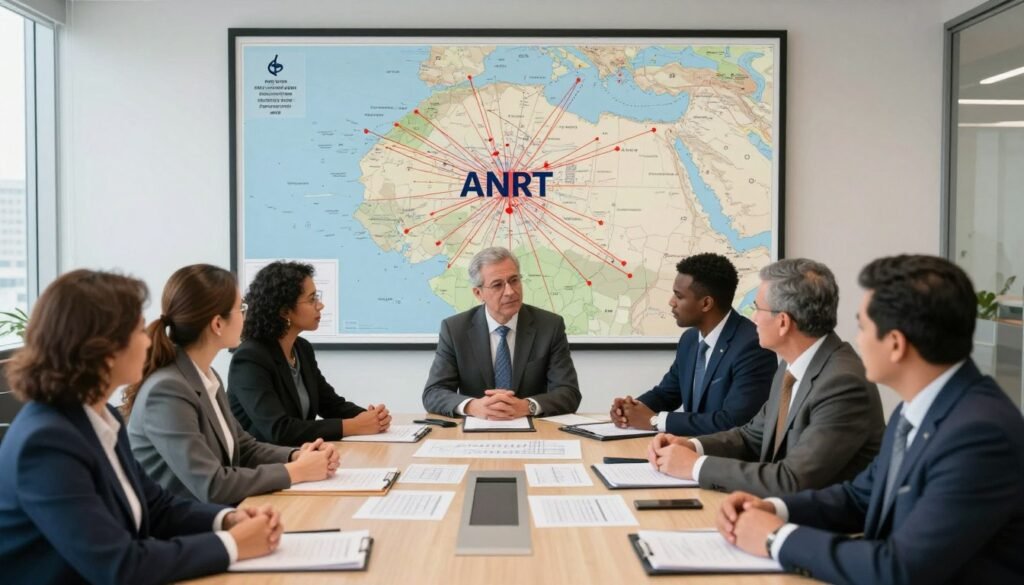
Dotée de la personnalité morale et d’une autonomie financière, l’agence jouit d’une indépendance opérationnelle essentielle. Elle est placée auprès du Chef du Gouvernement, soulignant son importance stratégique.
La continuité de son leadership est assurée par une succession de directeurs généraux expérimentés. Mostafa Terrab, Mohamed Benchaâboun, Azzeddine El Mountassir Billah et Az-El-Arabe Hassibi ont tous guidé l’institution.
Cette structure solide lui permet de réguler le service avec impartialité et une vision à long terme.
ANRT : Pilier de la Régulation Télécoms au Maroc
La stabilité du marché des télécoms au Maroc repose sur un socle réglementaire solide. Ce cadre définit des prérogatives étendues pour le régulateur.
Cadre juridique et missions essentielles
Le cadre légal permet à l’autorité de contribuer aux lois régissant les télécommunications. Il établit aussi les règles pour une concurrence loyale entre tous les opérateurs.
Parmi ses missions essentielles, elle arbitre les différends d’interconnexion. Elle gère aussi des ressources stratégiques comme le spectre radioélectrique.
Évolution et rôle dans le marché marocain
Son rôle a évolué d’un régulateur de base vers un facilitateur de l’innovation numérique. Elle approuve maintenant les offres commerciales des opérateurs.
Cela protège les consommateurs et garantit un service de qualité. Le traitement des réclamations et la gestion des noms de domaine « .ma » élargissent son action.
Ces responsabilités renforcent la confiance dans les services de télécommunications modernes.
Les services et régulations dans le secteur des télécommunications
Un marché diversifié de plus d’une dizaine d’opérateurs nécessite un cadre réglementaire clair et des processus simplifiés. La régulation offre ainsi des services essentiels et assure une surveillance constante.
Attribution des licences et procédures dématérialisées
L’attribution des licences constitue un service régalien essentiel. Il contrôle l’entrée de nouveaux acteurs sur le marché.
En octobre 2025, l’ANRT et l’ADII ont lancé une procédure totalement dématérialisée. Elle permet l’importation d’équipements via la plateforme PortNet.
Cette innovation supprime les documents papier. Elle accélère les délais et réduit les coûts pour les entreprises.
Surveillance du marché et garantie de la concurrence
La surveillance continue détecte rapidement les pratiques anticoncurrentielles. Elle garantit un environnement équitable pour tous.
Plus de dix opérateurs actifs couvrent divers segments. On trouve le fixe, le mobile, Internet, VSAT, GMPCS et 3RP.
Le régulateur supervise aussi les fournisseurs de service à valeur ajoutée. Il gère les prestataires de noms de domaine .ma.
Cette approche globale renforce la confiance dans le secteur des télécommunications.
Actualités et interventions de l’ANRT
L’année 2025 a été marquée par des avancées majeures pour le secteur des télécommunications au Maroc, sous l’impulsion de son autorité de régulation.
Licences 5G et innovations technologiques
En juillet 2025, un appel à concurrence historique a été lancé pour l’octroi des licences 5G. Cette étape cruciale ouvre officiellement la voie au déploiement des réseaux mobiles de cinquième génération.
Elle positionne le Maroc comme un pionnier régional dans l’adoption de cette technologie. Le déploiement de la 5G permettra une nouvelle génération de service ultra-rapide et fiable.
Des domaines comme l’Internet des objets, les villes intelligentes et l’industrie 4.0 en bénéficieront directement.
Initiatives collaboratives et projets récents
Parallèlement, une collaboration avec l’Administration des Douanes a abouti à une innovation majeure. Depuis octobre 2025, l’importation d’équipements de télécommunication est totalement dématérialisée via PortNet.
Cette procédure simplifiée accélère les délais et réduit les coûts pour les opérateurs. Le marché démontre une vitalité constante, avec près de 40 millions d’abonnements Internet recensés fin mars 2025.
Un taux de pénétration d’environ 108% reflète la multi-équipement des utilisateurs et la diversité de l’offre. Ces actions s’inscrivent dans une vision stratégique de transformation numérique pour le royaume.
Conclusion
Le secteur des télécoms marocain, aujourd’hui mature et innovant, est le fruit d’une régulation visionnaire et constante. Depuis 1998, l’ANRT a piloté la transition d’un monopole vers un marché dynamique de plus de dix opérateurs.
Cette transformation se mesure aux 39,9 millions d’abonnements Internet et à un taux de pénétration de 108%. Ces chiffres reflètent un accès large et une offre diversifiée.
La gestion du spectre, la garantie d’une concurrence loyale et la protection des usagers forment un cadre complet. Les projets récents, comme la 5G et la dématérialisation, illustrent cette agilité.
L’avenir s’annonce prometteur. Une régulation équilibrée positionne le Maroc comme un leader régional en télécommunications. Elle accompagnera la stratégie numérique nationale pour un développement économique et social durable.
FAQ
Comment puis-je porter plainte contre mon opérateur télécoms au Maroc ?
Vous pouvez déposer une réclamation directement auprès de l’Autorité Nationale de Régulation des Télécommunications. Le processus est simplifié via leur plateforme en ligne dédiée au traitement des litiges des consommateurs. C’est une démarche gratuite qui permet de résoudre les problèmes de facturation, de qualité de service ou de contrat avec des opérateurs comme Maroc Telecom, Orange ou Inwi.
Quels sont les principaux opérateurs de téléphonie mobile régulés sur le marché marocain ?
Le secteur est dominé par trois grands acteurs historiques : Maroc Telecom (Itissalat Al-Maghrib), Orange Maroc, et Inwi. L’autorité de régulation veille à ce que la concurrence entre ces entreprises soit loyale, ce qui profite aux usagers par des prix plus justes et des services innovants.
Quelle est la procédure pour obtenir une licence d’exploitation dans les télécoms ?
Les demandes de licence, comme pour la 5G, suivent une procédure officielle et dématérialisée. Les candidats doivent soumettre un dossier complet détaillant leur projet technique et financier. L’organisme de régulation examine ces demandes pour garantir leur conformité avec la loi et les objectifs de développement du secteur numérique national.
Quel est le rôle du régulateur dans le déploiement de la nouvelle technologie 5G ?
Son rôle est central. Il organise les appels à candidatures pour l’attribution des fréquences 5G, fixe les règles techniques et de couverture du territoire, et supervise l’équité du processus. Son action vise à accélérer l’arrivée de cette innovation tout en protégeant les intérêts des consommateurs et en stimulant la concurrence.
Où puis-je consulter les dernières décisions et rapports sur la qualité des réseaux ?
Toutes les publications officielles, y compris les rapports de mesure de la qualité de service (QoS), les décisions et les communiqués de presse, sont accessibles gratuitement sur le site web officiel de l’institution. C’est la source d’information la plus fiable pour suivre l’actualité du marché des télécommunications au Maroc.