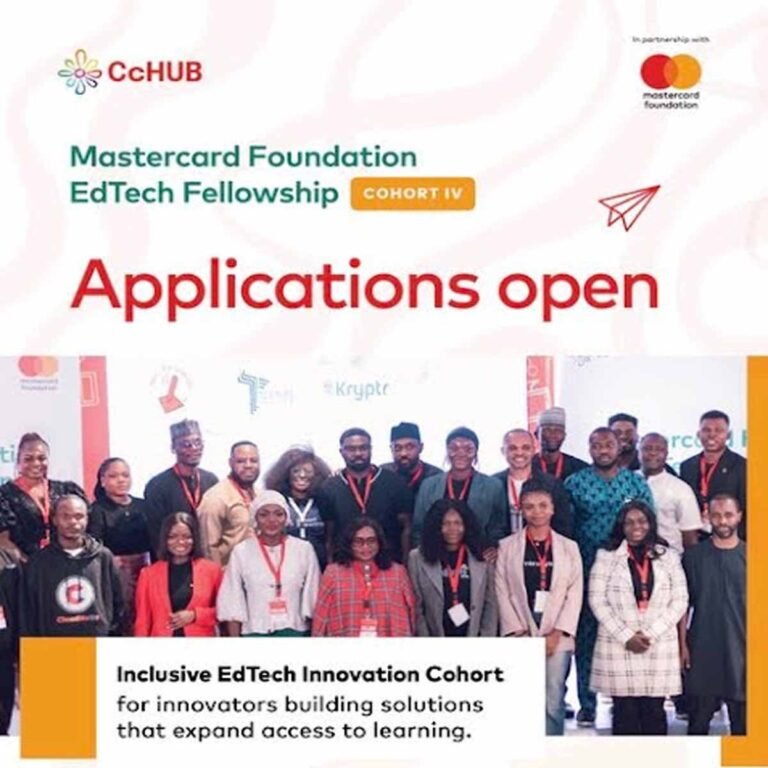
The Mastercard EdTech Fellowship Cohort 4 2026 is not just another startup support program. For many early-stage EdTech founders, it is a launchpad designed to turn a promising idea into a strong, inclusive, and scalable education solution. Led by CcHUB in partnership with the Mastercard Foundation, this fellowship targets startups building tools that can improve learning outcomes and expand access to education for communities that are too often underserved.
And let us be honest: in a world where many digital products are built for “ideal” environments, this program takes the opposite route. It starts with the realities on the ground. Limited infrastructure, interrupted schooling, gender inequality, disability, rural communities, displaced learners, and fragmented education data systems are not side issues here. They are the core context. In other words, this fellowship looks at education as it truly exists, not as we wish it did.
The Key Takeaways at a Glance
If we had to sum up this fellowship in one sentence, we would say this: it is a bridge between innovation and real-world impact. Cohort 4 focuses on early-stage EdTech startups. Selected companies may receive $100,000 in non-dilutive funding, product support, expert mentorship, access to ecosystem partners, and a structured 18-month journey, including 12 months of incubation and 6 months of post-incubation support.
Another critical point: applications for Cohort 4 are closed. The official program page shows the status as “Closed” and indicates that applications ended on April 10, 2026.
What Is the Mastercard EdTech Fellowship Cohort 4 2026?
At its core, the program is a fellowship for early-stage innovators building inclusive, context-aware, and genuinely effective learning solutions for underserved learners. That matters. This is not about launching the flashiest app or the trendiest platform. It is about creating products that work in real educational settings, especially where conditions are difficult and impact matters as much as growth.
An Initiative Powered by CcHUB and the Mastercard Foundation
The fellowship is implemented by Co-creation HUB (CcHUB), widely known as Nigeria’s first innovation center, founded in 2010 and active across several African countries. The Mastercard Foundation, on the other hand, supports initiatives connected to education and financial inclusion, helping young people access dignified and sustainable work. Together, they position this fellowship as a tool for transforming the African EdTech ecosystem.
A Program Designed for High-Impact Education Solutions
One of the fellowship’s biggest strengths is its philosophy. Instead of supporting products built in a vacuum, it prioritizes startups solving real problems in real environments: schools with weak internet access, rural communities, learners with disabilities, girls facing structural barriers, and education systems that need stronger data to make better decisions. It is a practical approach. And in EdTech, practicality often beats hype.
Why Cohort 4 Truly Matters
The official program description explains that many learners in Nigeria, and across the continent, face infrastructure gaps, interrupted education, gender disparities, disability-related exclusion, and weak education data systems. In this reality, too many EdTech solutions have historically been designed for more stable environments. Cohort 4 aims to correct that blind spot.
A Response to the Blind Spots of Mainstream EdTech
Let us face it: many digital learning products are like race cars on roads that do not exist. They assume strong internet, available devices, consistent usage, and neat learning journeys. But that is not the reality for millions of African learners. The Mastercard EdTech Fellowship Cohort 4 recognizes this and supports founders who design for constraints rather than pretending those constraints are not there.
A Strong Signal to Impact-Driven Founders
CcHUB’s message is clear: inclusive innovation is not a side category. It is a priority. This cohort reflects a commitment to solutions that serve learners too often ignored by mainstream innovation. That is not just inspiring. It is strategically smart. The best products are often built where the need is deepest.
Who Can Apply to This Program?
The official fellowship page outlines several target areas. The program is aimed at EdTech startups building solutions for specific groups and educational challenges.
Startups Designing for Learners with Disabilities
The first priority area includes solutions for learners living with disabilities. We are talking about tools that make learning more accessible, adaptable, and effective. This may include content accessibility, specialized support, adaptive interfaces, or inclusive learning methods.
Solutions for Displaced People, Rural Communities, and Other Underserved Groups
The second focus area includes startups responding to the needs of internally displaced persons (IDPs), rural communities, and other underserved groups. This is an important segment because it forces founders to think seriously about delivery, resilience, and actual usage. A great idea is not enough. It has to work in the field.
Products Focused on Young Girls and Women
The third area centers on solutions for young girls and women. This is significant. It recognizes that girls’ education is not just a social issue. It is also an economic, developmental, and equity issue. Startups solving this challenge are working at the intersection of urgent need and long-term opportunity.
Tools for Education Data Systems
The fellowship also welcomes solutions built for national and subnational education data systems. At first glance, this may seem less exciting than consumer-facing products. But in reality, it is fundamental. Without reliable education data, decision-makers are steering in the dark. And trying to improve an entire education system without good data is like sailing at night without a lighthouse.
What Are the Benefits for Selected Startups?
This fellowship offers more than visibility. It provides a practical, structured support package aligned with what early-stage startups actually need to grow.
$100,000 in Equity-Free Funding
This is probably the headline benefit: selected startups may receive $100,000 in non-dilutive funding. In plain English, that means the funding does not require founders to give up equity. For an early-stage company, that is extremely valuable. It gives room to build, test, improve, and grow without weakening long-term ownership too early.
Mentorship from Experts in Education, Technology, and Innovation
The program also includes expert mentorship from professionals in education, technology, and innovation. This type of support can be just as valuable as the funding itself. Why? Because startups rarely fail from lack of passion. More often, they struggle because they lack structure, perspective, method, and access to the right people at the right time.
Support in Product Development and Inclusive Design
Fellows also receive support in product development and inclusive design. This is a major advantage. The fellowship does not just help startups “scale”; it helps them build products that are more useful, more accessible, and more credible. In education, building fast is not enough. Building right matters more.
Access to Ecosystem Partners and Implementation Opportunities
The program offers access to ecosystem partners and implementation opportunities. In other words, startups are not left alone with a theoretical market strategy. They are connected to real networks for testing, partnership, adoption, and deployment. And that is often where the difference between a promising demo and a successful product becomes clear.
A Path Toward Sustainability and Growth
CcHUB also emphasizes support aimed at strengthening impact, sustainability, and growth. This makes the program stand out. It is not about a few weeks of publicity or surface-level excitement. It is about helping startups build lasting foundations.
How Is the Program Structured?
One of the most impressive parts of the fellowship is its structure. The official page describes a full 18-month journey, divided into two main phases.
Phase 1: 12 Months of Intensive Incubation
The first phase is a 12-month incubation period. During this stage, startups receive deep technical support and implementation-focused guidance. That duration matters. It gives founders enough time to diagnose problems, experiment, adjust, and strengthen their offering. In EdTech, growth rarely follows a shortcut.
Learning Science: Building on Evidence-Based Pedagogy
The program includes a Learning Science component focused on embedding evidence-based pedagogical principles into startup products. That is excellent news. Too many EdTech products confuse activity with learning. A student clicking more does not automatically mean a student learning more. This fellowship clearly understands that educational effectiveness should remain at the center.
Human-Centered Design: Building with Users, Not for Them
The fellowship also includes Human-Centered Design, with inclusive design practices developed alongside target users. That is a powerful principle. Instead of building in isolation and assuming what people need, startups are encouraged to observe, listen, test, and refine. It may sound simple, but this approach often separates meaningful solutions from forgettable ones.
User Research: Understanding the Field Before Scaling
Another major piece is User Research, including research connected to special education, gender inclusion, education systems, and policy. Once again, the program sends a strong message. It does not push founders to scale blindly. It pushes them to understand first. And understanding, in a complex market, already saves time, money, and credibility.
Product Development: Testing in Real Contexts
The incubation phase also includes Product Development support aimed at testing solutions in real-life environments and strengthening readiness for adoption. This is essential. A product that performs beautifully in a presentation but fails in an actual classroom has not truly found its fit. The fellowship encourages healthy, necessary contact with reality.
Phase 2: 6 Months of Post-Incubation Growth Support
After incubation, selected startups receive six months of follow-on support focused on growth and long-term sustainability. This is where the shift happens: from building the product to expanding its reach.
Go-to-Market Strategy: Refining the Business Model
The program supports startups on Go-to-Market Strategy, including business models, pricing, and user acquisition. This is a critical stage. In EdTech, a strong mission does not remove the need to answer one simple question: who pays, why, and how?
Investment Readiness: Preparing for Future Fundraising
The second phase also includes Investment Readiness workshops, mentorship, and support for fundraising and investor pitching. This shows that the fellowship is not only focused on the present. It is also preparing startups for the next step: approaching funders, investors, or institutional partners with stronger stories, better metrics, and a clearer roadmap.
Distribution and Partnerships: Opening the Right Doors
The program includes visibility opportunities, such as through the EdTech Festival, as well as introductions to distribution and implementation partners. In practice, this can save startups months of effort. In many markets, the right introduction is worth more than endless cold outreach.
Branding and Marketing: Building Trust
Finally, the fellowship offers support in Branding and Marketing to strengthen brand identity and user trust. That may sound secondary, but it is not. In education, trust is currency. Without it, even the best product struggles to gain traction.
How Many Startups Will Be Selected and What Is the Program’s Track Record?
According to CcHUB’s official communication, 12 early-stage startups are expected to be selected for Cohort 4. CcHUB also states that since the fellowship began, it has supported 72 companies across Africa, which have reached more than 700,000 new learners. Of those learners, 89% are children and youth, with a gender split of 49% female and 51% male.
These numbers do not tell the whole story, of course. But they do tell us something important: this fellowship is not a first-time experiment. It is built on existing experience, a growing portfolio, and measurable outcomes. For founders, that matters. It is always better to board a train that has already moved.
The Timeline for the 2026 Call for Applications
Based on the official program page and CcHUB’s announcement, applications for Cohort 4 opened on February 27, 2026 and closed on April 10, 2026. The program page now displays the status “Closed”, while the broader Future of Learning platform notes that Cohort IV applications are closed and under review.
What Does This Closure Mean?
Simply put, entrepreneurs can no longer apply for this specific cohort. However, the information remains useful for three main reasons. First, it helps founders prepare early for future cohorts. Second, it gives a clear view of the program’s standards and priorities. Third, it offers a practical framework for startups that want to improve their positioning before the next opportunity appears.
Why This Fellowship Draws So Much Attention in the African Startup Ecosystem
This program brings together several rare ingredients in one place: non-dilutive funding, long-term support, an inclusion-first approach, a clear structure, and institutional credibility. It is not just another pitch contest. It is a startup-strengthening mechanism that touches product, user research, distribution, capital readiness, and brand development.
Because It Treats EdTech as Infrastructure, Not as a Trend
This may be the fellowship’s smartest feature. It does not treat EdTech as a fashionable buzzword. It treats it as social infrastructure. When a program pushes founders to think about inclusion, implementation, learning outcomes, partnerships, and sustainability, it trains them to build something deeper than a startup. It pushes them to build something that matters.
How to Prepare a Strong Application for a Future Cohort
Even though Cohort 4 is closed, there are valuable lessons for future applicants.
1. Show a Real, Clear, and Urgent Problem
A strong application should not begin with the technology. It should begin with the problem. Which specific learner group are you serving? What educational barrier are you removing? Why does the problem matter now? The more grounded your answer, the stronger your application becomes.
2. Align Clearly with the Program’s Priorities
The fellowship focuses on clear areas: disability, girls and women, displaced populations, rural communities, and education data systems. If your startup fits one of these categories, prove it directly. Do not hint. Show it with examples, use cases, and evidence.
3. Treat Inclusion as a Product Advantage
Inclusion should not be presented like a moral decoration added at the end of a pitch deck. It should be visible inside the product itself: in the design, interface, distribution model, content format, pricing logic, offline usage, measurement system, and support structure.
4. Demonstrate Execution Capacity
Early-stage does not mean unprepared. Even at an early stage, a strong startup can show:
- a working prototype;
- user testing;
- early field feedback;
- pilot partnerships;
- a clear logic for growth.
5. Speak the Language of Impact and Business
Many teams know how to talk about mission. Fewer know how to talk about sustainability. But a strong EdTech startup must stand on two legs: impact and business viability. Without impact, it loses meaning. Without a model, it runs out of energy before it reaches scale.
Mistakes to Avoid
Some errors appear again and again in applications to programs like this.
Trying to Serve “Everyone”
When a startup says it is for everyone, it is often really for no one. The fellowship values contextualized solutions. Choose your audience, understand them deeply, and be specific.
Confusing Innovation with Complexity
An innovative product is not necessarily a complicated one. In constrained environments, simplicity is often a smart advantage. A lighter, more reliable, and easier-to-use solution can outperform a richer but impractical platform.
Ignoring Adoption Reality
A good product does not exist only on a screen. It exists inside schools, homes, institutions, and communities, each with their own habits, costs, decision-makers, and barriers. Forgetting that is like building a bridge without checking whether it actually leads anywhere.
Neglecting Proof of Real Learning Outcomes
In EdTech, vanity metrics are tempting: downloads, clicks, impressions, and sign-ups. But this fellowship emphasizes improved learning outcomes. That means founders should think seriously about educational effectiveness, retention, sustained usage, and real value for the learner.
What This Call for Applications Reveals About the Future of EdTech in Africa
At a deeper level, this call tells a bigger story. It shows that the ecosystem is evolving. We are moving beyond simply asking whether a solution is digital. We are entering a phase where startups are expected to be useful, measurable, inclusive, and deployable. And that is a very good sign.
The Mastercard EdTech Fellowship, as presented by CcHUB and highlighted by Start-up.ma, also shows that Africa is not merely adapting models from elsewhere. It is shaping its own support systems, guided by its own priorities, realities, and opportunities. That may be the strongest message of Cohort 4: innovation rooted in African realities to solve major African education challenges.
Conclusion
The Mastercard EdTech Fellowship Cohort 4 2026 stands out as one of the most relevant opportunities for high-impact early-stage EdTech startups. With its $100,000 equity-free funding, 18-month structured support, strong emphasis on underserved learners, and focus on sustainability, it clearly rises above more general startup accelerator programs. Even though applications closed on April 10, 2026, this cohort remains an excellent model for any startup that wants to sharpen its positioning, improve its storytelling, and prepare more strategically for future opportunities. In short, this fellowship is more than a funding opportunity. It is a compass for the future of African EdTech.
FAQs
1. Is the Mastercard EdTech Fellowship Cohort 4 2026 still open?
No. The official program page states that Cohort 4 is closed, with applications ending on April 10, 2026.
2. How much funding does the program offer?
Selected startups may receive up to $100,000 in equity-free funding, meaning they do not need to give up ownership shares in exchange for the funding.
3. Who is eligible for the program?
The fellowship targets early-stage EdTech startups building solutions for learners with disabilities, rural or displaced communities, girls and women, and education data systems.
4. How long does the fellowship last?
The full program lasts 18 months, made up of 12 months of incubation and 6 months of post-incubation support focused on growth and sustainability.
5. Why is this program important for the African EdTech ecosystem?
Because it supports inclusive, context-aware solutions for underserved learners while combining funding, mentorship, product support, distribution access, and investment readiness.