
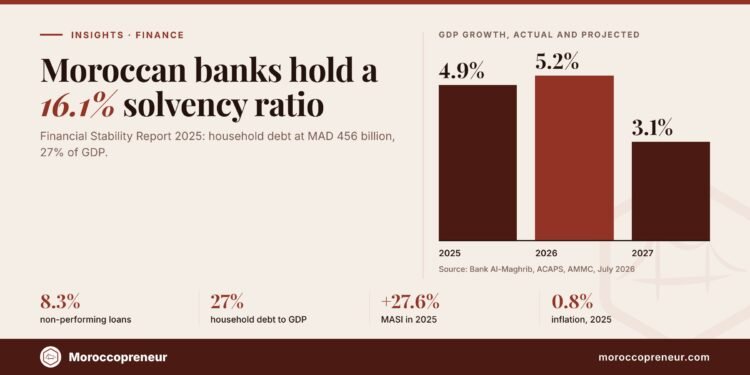
Moroccan banks held an average solvency ratio of 16.1% at the end of 2025, while household debt reached MAD 456 billion, about 27% of GDP, according to the Financial Stability Report for 2025, the 13th edition published jointly by Bank Al-Maghrib, the insurance regulator ACAPS and the capital market authority AMMC in July 2026. The report finds the financial system resilient.
For founders, investors and finance professionals in Morocco, the report gives the official view of credit, banks, insurers and the stock market heading into 2027.
About the report
| Publisher | Bank Al-Maghrib, ACAPS and AMMC, under the Systemic Risk Coordination and Monitoring Committee (CCSRS) |
| Released | July 2026 (approved by the CCSRS on 7 July 2026) |
| Title | Rapport annuel sur la stabilité financière, exercice 2025 (13th edition) |
| Data covered | Macroeconomy, banks, insurance, capital markets, household and corporate debt, 2025, with projections to 2027 |
| Latest edition? | Yes, as of November 2026. Published every year, in French. |
Key figures
- Growth reached 4.9% in 2025, after 4.4% in 2024, and Bank Al-Maghrib projects 5.2% in 2026 and 3.1% in 2027. Inflation was 0.8% in 2025, according to the report.
- Banks held an average solvency ratio of 16.1% and a Tier 1 ratio of 13.5%. The non-performing loan ratio eased to 8.3% from 8.4%, with coverage of about 68%.
- Loans to customers grew 6.9%, and credit to the non-financial sector accelerated to 4.8% in 2025 from 2.6% in 2024, with 6.8% projected for 2026.
- Household debt reached MAD 456 billion, about 27% of GDP, while household financial assets stood at MAD 1,192 billion, the report shows.
- Insurers grew revenue 7.5% to MAD 63.2 billion and net profit 21.4% to MAD 5.3 billion, with a solvency margin ratio of 409.4%.
- The MASI stock index gained 27.6% in 2025, with trading volume of MAD 137.3 billion. Stress tests show banks and insurers can absorb severe shocks, and the countercyclical capital buffer stays at 0%, according to the report.
Main indicators for 2025, according to the Financial Stability Report:
| Indicator | 2025 |
|---|---|
| GDP growth | 4.9% |
| Inflation | 0.8% |
| Bank solvency ratio | 16.1% |
| Non-performing loan ratio | 8.3% |
| Household debt | MAD 456 billion (27% of GDP) |
| MASI index performance | +27.6% |
What these figures mean for Moroccan businesses and investors
- Banks can lend more. Solid capital ratios and a projected rise in credit growth suggest banks have room to finance businesses with credible plans.
- Credit quality still matters. With 8.3% of loans non-performing, banks will keep screening carefully. Clean accounts and realistic projections improve access to finance.
- Households are borrowing again. Household debt at 27% of GDP points to returning consumer demand, but also to a ceiling for businesses that rely on consumer credit.
- The stock market is active. A 27.6% gain on the MASI and strong insurer results widen financing options beyond bank loans for larger companies.
For the latest quarterly outlook, see our summary of the HCP’s October 2026 economic outlook note.
📥 Read the full report
The full report is available free of charge, in French, from the three authorities. The report is published by Bank Al-Maghrib, ACAPS and AMMC, not by Moroccopreneur.
FAQ
They held an average solvency ratio of 16.1% and a Tier 1 ratio of 13.5% at end-2025, and stress tests show they can absorb severe shocks.
MAD 456 billion at end-2025, about 27% of GDP.
5.2% in 2026 and 3.1% in 2027, after 4.9% in 2025.
Bank Al-Maghrib, ACAPS and AMMC, jointly, under the Systemic Risk Coordination and Monitoring Committee (CCSRS).
Sources
- Bank Al-Maghrib, ACAPS and AMMC: Rapport annuel sur la stabilité financière, exercice 2025 (PDF)
- AMMC: CCSRS press release, 23rd meeting, 7 July 2026 (PDF)