
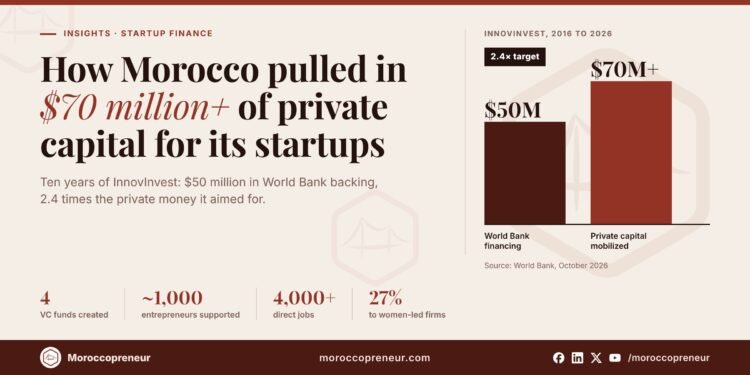
Morocco’s InnovInvest program mobilized more than $70 million in private capital for startups, 2.4 times its initial target, according to a World Bank results story published on 12 October 2026. Backed by $50 million in World Bank financing since 2016, the program helped create four venture capital funds and supported close to 1,000 entrepreneurs. Source: World Bank, “How Morocco Unlocked Private Capital for Startups”.
What does the World Bank publication cover?
The publication is a World Bank feature story that reviews ten years of InnovInvest. The program was launched in 2016 with Morocco’s Ministry of Economy and Finance. Through Tamwilcom, the public body for business guarantees and financing, the state co-invested alongside private investors to share the risk of backing young companies.
The World Bank sets this against the starting point: about ten years earlier, early-stage deals made up only 6% of equity investment in Morocco. The story is a results summary rather than a full evaluation report, and it is the most recent World Bank publication on the program as of October 2026.
What are the key results?
| InnovInvest result | Figure |
|---|---|
| World Bank financing | $50 million |
| Private capital mobilized | More than $70 million (2.4 times the target) |
| Venture capital funds created | 4 |
| Entrepreneurs supported | Close to 1,000 |
| Direct jobs created | More than 4,000 |
| Incubators and accelerators accredited | 16 |
| Share of financing to women-led companies | 27%, above the project’s target |
The World Bank also points to what comes next. A $250 million digital acceleration program was approved in June 2026, and a $300 million risk-sharing facility for small and medium-sized enterprises marks the first collaboration between IFC and Tamwilcom.
What does this mean for Moroccan founders and investors?
There is now a local venture capital layer to pitch. Four professional funds came out of this program alone. Founders who once had to look abroad for a first institutional round have more options at home, especially at seed and early stage.
Accredited incubators are the front door. With 16 incubators and accelerators accredited under the program, joining one is often the most direct route to early financing and to the investors connected to it.
Women founders have a measurable foothold. 27% of financing went to women-led companies, above target. That is still far from parity, and it gives ecosystem organizations a baseline to track.
Public co-investment changes the risk math for investors. The state sharing early-stage risk is what pulled in 2.4 times the expected private money. For international and diaspora investors, the next programs, focused on digital acceleration and SME risk-sharing, are the ones to watch. For a wider view of the ecosystem, see our coverage of investing in Morocco.
Frequently asked questions
What is InnovInvest?
InnovInvest is a Moroccan program, launched in 2016 with World Bank support, that co-invests public money alongside private investors to finance startups and build a venture capital market.
Who runs the program in Morocco?
It was designed with the Ministry of Economy and Finance and implemented through Tamwilcom, Morocco’s public body for business guarantees and financing.
How much private capital did it attract?
More than $70 million, which is 2.4 times the initial target, according to the World Bank.
Is there a full evaluation report?
The World Bank publication is a results story. It does not link to a separate evaluation report.