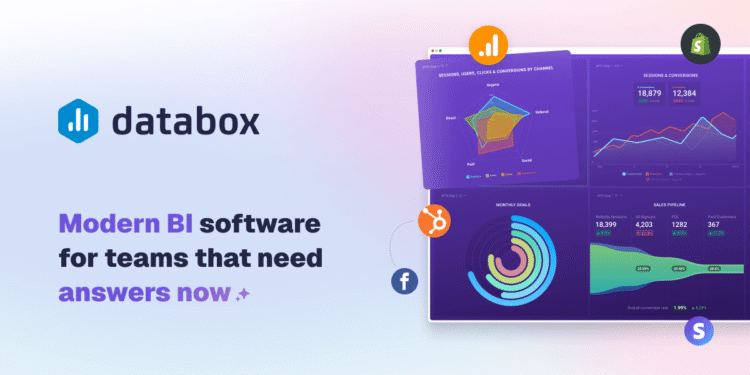
Databox is a business intelligence platform that pulls data from marketing, sales, finance, and other connected tools into one live dashboard, so a founder or program team can report real numbers instead of rebuilding a spreadsheet before every board meeting. Moroccan startups and ecosystem organizations already juggling three or more reporting tools should look at Databox before their next investor update.
Key features
Based on Databox’s own product pages as of September 2026, the platform offers:
- Over 130 native integrations spanning marketing, sales, finance, and productivity tools, plus spreadsheet imports and custom API or database connections for anything not natively supported.
- Customizable dashboards that can be shared through a link viewable without a login, useful for sending a live board or funder report instead of a static PDF.
- Databox Genie, an AI analyst that answers plain-language questions grounded in a company’s own connected data rather than generic web knowledge.
- Goals and OKR tracking that measures live performance against set targets automatically, instead of someone updating a tracker by hand.
- Scheduled, automated reports that turn a dashboard into a document sent on a recurring basis.
- A governed metrics layer with defined, verified metric ownership and permission-based access, so different team members see only what they should.
- A mobile app for checking KPIs away from a desk.
- SOC 2 certification and GDPR-aligned data practices, with Databox stating customer data is not used to train its AI models.
Pricing
Databox’s published pricing page lists six tiers. A Free plan covers one user, three data sources, one dashboard, and 50 AI credits a month at no cost. The Analyst plan runs $71 a month billed annually for one user, five data sources, 150 AI credits, plus custom integrations, API access, and MCP server access. Team Core is $249 a month billed annually for three users and ten data sources, and Team Scale is $399 a month billed annually for ten users, 30 data sources, and sub-accounts. An Agency plan starts at $99 a month billed annually with 20 data sources and unlimited users, with additional client packs sold separately. A Custom plan is quote-based for larger implementations. Paid plans include a 14-day free trial with no card required upfront.
Third-party listings for Databox show different numbers and plan names than what we found directly on the vendor’s own site, which tells us this pricing structure moves. Treat the figures above as a starting reference, not a quote, and confirm current tiers and data source limits on Databox’s pricing page before budgeting for it.
Last verified: September 2026, against Databox’s own pricing page.
Pros and cons
| Pros | Cons |
|---|---|
| Wide integration list covers most tools already used by Moroccan founders: analytics, CRM, payments, spreadsheets. | Cost scales with data sources and AI credits, so a growing team can outgrow a tier faster than expected. |
| Dashboards can be shared with investors or board members without requiring them to create an account. | The entry paid tier (Analyst) covers only one user, meaning most teams need to jump to a Team plan quickly. |
| Free plan is usable enough to test the product before committing budget. | Setup and metric configuration have a learning curve for staff without a data or marketing analytics background. |
| Goal and OKR tracking ties reporting directly to targets instead of a separate spreadsheet. | Interface and support are built for an English-speaking market; we found no published Arabic or French interface option. |
| SOC 2 certification and GDPR-aligned handling give some assurance for funder due diligence. | Deeper AI features (Genie, MCP, agents) mostly matter to teams already comfortable working with AI tools, less so to a small program team wanting a simple report. |
Who it’s best for
Databox fits a Moroccan founder or ecosystem organization already pulling numbers from several places, say Google Analytics, a CRM, a payment processor, and a spreadsheet of program participants, who needs one dashboard to hand to a board, an investor, or a funder without rebuilding it every quarter. It also fits an incubator or accelerator that needs to show live cohort or portfolio metrics to a donor rather than a static end-of-program report.
Skip it if you only report from one or two tools that already export a clean enough summary on their own, if your reporting cadence is annual rather than monthly or quarterly, or if in-platform Arabic or French labeling matters more to your team than English, since we could not confirm that Databox offers it.
How to get started
- Go to Databox’s website and start on the Free plan, no card required.
- Sign up with a work email or a Google account.
- Connect your first data source, such as Google Analytics, a CRM, or a spreadsheet.
- Pick a pre-built dashboard template that matches your KPIs, or build one from your connected metrics directly.
- Set sharing permissions and generate a login-free link for your board, investors, or funders.
- Upgrade to a paid plan once you need more data sources, more team members, or more AI credits than the Free tier allows.
FAQ
Does Databox have a free plan? Yes. As of September 2026, the Free plan supports one user, three data sources, one dashboard, and 50 AI credits a month, at no cost.
Can investors or board members view a dashboard without creating a Databox account? Yes. Dashboards can be shared through a link that opens without requiring the viewer to sign up or log in.
How many tools do I need to connect before Databox makes sense? There is no fixed rule, but a team pulling from three or more reporting tools tends to get more value from consolidating into one dashboard than a team relying on one or two.
Does Databox work in Arabic or French? We could not confirm published Arabic or French interface support on Databox’s own site as of this review. If in-platform localization is a requirement for your team, confirm directly with Databox before subscribing.
Disclosure: Moroccopreneur may earn a commission if you sign up for Databox through the links in this article. This does not change what you pay, and it does not influence which tools we choose to cover.